PPI Calls for the Federal Reserve to Stop Higher Banking Fees

WASHINGTON (June 5, 2026) — This week, the Progressive Policy Institute (PPI) filed an amicus brief in the case Linney’s Pizza, LLC v. Board of Governors of the Federal Reserve System at the U.S. Court of Appeals for the Sixth Circuit.

Paul Weinstein Jr., Senior Fellow at PPI, stated that “Attempts to force the Fed to further reduce interchange fees, while well-meaning, would, based on recent economic studies, provide no financial relief to consumers and instead could lead to higher banking fees.”

Last fall, PPI released a study by former Undersecretary for Commerce Robert Shapiro that showed the Federal Reserve’s cap on debit card interchange fees failed to deliver promised savings for consumers, and instead reduced access to free checking, led to higher maintenance and overdraft fees, and pushed billions of dollars in spending toward higher fee credit cards.

Read the full brief here.

Founded in 1989, PPI is a catalyst for policy innovation and political reform based in Washington, D.C. Its mission is to create radically pragmatic ideas for moving America beyond ideological and partisan deadlock. Find an expert and learn more about PPI by visiting progressivepolicy.org. Follow us at @PPI.

###

Media Contact: Ian O’Keefe – iokeefe@ppionline.org

Marshall for The Hill: The Democrats’ Choice: Polarize From the Left or Win the Middle

President Trump’s shambolic mess of a second term is getting sucked into a political sinkhole. Polls show he is now underwater even among white working-class voters, the molten core of his populist insurgency.

This follows eroding support over the past year among independents, working-class Hispanics and young voters. Trump can still count on a solid MAGA base to vote out Republicans who don’t blindly obey his orders. But most Americans have turned thumbs down on his inflationary tariffs, capricious military attacks and brazen corruption.

No wonder Democrats are feeling upbeat about the midterm elections. Whatever gains they make, however, will likely prove fleeting unless the party finally tackles its strategic imperative since Trump crashed the political stage in 2016: reconnecting with America’s non-college majority.

Keep reading in The Hill.

Ainsley on Talking Progress: Industrial Heartlands: Shifting the Tide through Local Leadership

How can structural transformation in former industrial regions be managed in a way that fosters economic resilience, climate action, and democratic trust?

In the fifth episode of our “Talking Progress” series, we put the spotlight on the crucial role of local governance. Looking at the Industrial Heartlands in both the US and Germany, we explore how local governments shape the day-to-day lives of citizens, and why delivering reliable answers on the ground is the most effective remedy against the populist radical-right.

Guenther and Perez Quinn for the Baltimore Sun: Proposed cuts to satellite funding are a threat to science

This World Environment Day, we should look up to the skies and say thank you to the nearly 1,500 hardworking Earth observation satellites that help us understand our changing planet. 

There are things about Earth that we can only see and study from the vantage of space. Through world-renowned agencies like NASA, NOAA and the National Center for Atmospheric Research, the U.S. heavily invests in remote sensing technologies, cutting-edge missions and world-class scientists, including at the Johns Hopkins University Applied Physics Laboratory in Laurel. As a result, data from space is interwoven into all aspects of our lives, from the air we breathe to the water we drink and the food we eat.

Over half of the information we rely on to understand Earth’s climate — including cloud cover and water vapor levels — comes from space. This vantage point gives us insight into the amount of tree cover and whether a wildfire is starting more efficiently than we could relying solely on ground instruments.

Earth observations also play a key role in “science diplomacy” — in other words, by supporting partnerships between nations centered on scientific exchanges that improve lives. The United States is typically the nation of choice for these partnerships because of our advanced space capabilities.

Read more in the Baltimore Sun

Net-Zero Deadlines Could Cost New Mexico Families, PPI Finds

WASHINGTON (June 4, 2026) — The Progressive Policy Institute (PPI) today released a new report, “The New Mexico Dilemma: Balancing Net-Zero Ambitions with Energy Realities,” warning that the state’s aggressive net-zero timeline could undermine grid reliability and energy affordability unless it is paired with firm, fully-scaled, carbon-free power. Authored by Neel Brown, Managing Director at PPI, and John Kemp, an internationally recognized expert on energy markets and systems, the report calls on policymakers to prioritize technology-neutral, outcome-based strategies over fixed net-zero dates.

New Mexico is the nation’s second-largest oil producer and fourth-largest gas producer, and the oil and gas industry is the state’s largest private-sector funder and a major driver of state budget revenues. The state is pursuing a 100% clean grid by 2045 and net-zero emissions by 2050, goals set by executive order in 2019 but never codified by the legislature. Unlike energy-producing peers such as Pennsylvania and Illinois, New Mexico has no nuclear generation and very little hydropower to supply carbon-free baseload, raising the risk that retiring gas generation too quickly could create capacity shortfalls, price spikes, and lost industrial investment.

The report finds the state has cut carbon emissions by 21% since the goals were set, primarily by switching from coal to natural gas, far short of the 45% reduction targeted for 2030. New Mexico also maintains some of the strictest methane rules in the country, requiring operators to capture 98% of natural gas waste and banning routine venting and flaring. Its emissions intensity is half that of Texas.

The authors note that New Mexico is not facing the demand surges and price shocks straining other states. Both grids serving the state, the Southwest Power Pool and WECC-Southwest, hold ample reserve margins expected to remain healthy through 2030. Residential electricity prices have fallen in real terms since 2019 and have risen just 3.7% over the past year, less than half the national average increase.

To protect that advantage, the report recommends three priorities:

  1. Adopt technology-neutral, outcome-based policies focused on reducing atmospheric carbon rather than banning specific fuels
  2. Invest in clean firm power such as geothermal, battery storage, and advanced nuclear to backstop wind and solar
  3. Protect consumer affordability by using the newly established $210 million Community Benefit Fund to keep transition costs from falling on rural and low-income ratepayers

“New Mexico has a rare opportunity to cut emissions without sacrificing reliability or affordability, but only if policy follows the realities on the ground,” said Neel Brown. “Arbitrary deadlines are not a substitute for firm, carbon-free power that is actually built and running.”

Read and download the report here.

Founded in 1989, PPI is a catalyst for policy innovation and political reform based in Washington, D.C. Its mission is to create radically pragmatic ideas for moving America beyond ideological and partisan deadlock. Find an expert and learn more about PPI by visiting progressivepolicy.org. Follow us at @ppi.

###

Media Contact: Ian O’Keefe – iokeefe@ppionline.org

The New Mexico Dilemma: Balancing Net-Zero Ambitions with Energy Realities

New Mexico is the nation’s second-largest oil producer and fourth-largest gas producer. The oil and gas industry is the state’s largest private sector funder and a massive driver of state budget revenues. Currently, the state is pursuing an aggressive 100% clean grid by 2045 and net-zero emissions by 2050. These goals were established by executive orders in 2019, but not enacted by the legislature. Unlike other energy-producing states like Pennsylvania and Illinois, New Mexico has no nuclear generation and very little hydropower for carbon-free baseload generation. The state’s push for retiring gas generation without firm-power replacements that are fully scaled risks capacity shortfalls, price spikes, and driving industrial investments to other states.

The good news is that New Mexico is not facing the dramatic spikes in energy demand and prices that many other states are experiencing. However, doubling down on climate goals without regard for the on-the-ground realities could throw the state into a world of energy scarcity and high prices.

A reasoned and pragmatic approach to lowering carbon emissions should take precedence over arbitrary net-zero dates that do not prioritize the realities of New Mexico’s economic drivers, jobs, energy costs, and grid reliability.

Read the full report

Manno for Datiak12: The Expectations Trap: Teachers Need Clarity

America’s teacher workforce problem is usually described in familiar terms, including pay, burnout, vacancies, long hours, and keeping talented educators in classrooms.

But a new Walton Family Foundation-Gallup report, Teaching for Tomorrow: Closing the Expectations Gap, points to another problem hiding in plain sight.

Based on a representative sample of more than 2,000 public K-12 teachers, it finds that many teachers believe they’re asked to meet expectations that are unclear, unrealistic, or disconnected from conditions in their schools. Teachers are more likely to be engaged, satisfied, and willing to stay in the classroom when they believe the expectations placed on them are realistic and clearly communicated.

That may sound obvious. But in schools, the obvious can get buried under mandates, initiatives, curriculum changes, accountability goals, technology shifts, and improvement plans.

Read more in Datiak12

831 data centers are under construction in the United States

FACT: 831 data centers are under construction in the United States.

THE NUMBERS: Taiwanese GDP growth* –

Actual, Q1 2026 14.60%
Taiwan government full-year forecast (May 2026) 9.60%
21st-century average rate 3.10%

Taiwan Directorate-General for Budget, Accounting, and Statistics for 2026 figures; IMF World Economic Outlook database for 21st-century average.

WHAT THEY MEAN: 

The Chinese calendar’s twelve animals and five elements, rotating on their 60-year cycle, converge to make 2026 a “Fire Horse” year. Horses are said to embody energy and independence; fire, passion and inspiration. Writing in Taipei-based CommonWealth Magazine, Judy Lin says such a year:

“Brings a surge of intensity, momentum, and transformative change. This once-in-60-
years combination amplifies courage and restlessness, rewarding bold action while
testing focus and restraint.” 

Taiwan’s stat people provide data support for Ms. Lin’s high-energy forecast: their laconic GDP release last Friday reports that — precisely as she was writing up the zodiac outlook — the Taiwanese economy was growing at a rate of 14.6%, and predicted 9.6% over the full year. Setting aside an anomalous 10.5% rebound after the financial crisis in 2010, that would be Taiwan’s biggest growth surge in 40 years and triple the island’s 21st-century average.

What has happened? The background is the worldwide, and particularly American, surge of investment into AI data centers. Some samples:

* McKinsey estimates $7 trillion going into data centers over the next five years, with 40% of it spent in the United States. The global total would account for about 1% of the world’s likely $690 trillion in GDP over these years, and the ~$2.8 trillion U.S. investment would be about 1.6% of U.S. GDP.

* UNCTAD says data center-building accounted for a fifth of the $1.6 trillion in “greenfield” FDI investment last year.

DataCenterMap, which counts the number of actually operating data centers, reports 11,534 live worldwide, including 4,312 in the United States, and Bloomberg NEF says Americans are building 831 new ones.

In sum, lots of construction projects, huge amounts of money spent to build them, and as data centers prepare to go live, they quickly fill up with AI chips, server racks, motherboards, graphics processing units, cooling systems, CPUs, and the like. The world’s largest centers for production of these things are the three Science Park complexes Taiwan launched in the 1970s – Hsinchu, Southern Taiwan, Central Taiwan — which now serve as home bases for semiconductor and IT hardware manufacturers of the TSMC, UMC, MediaTek, Foxconn, etc. type.  For the past two years, they have been sending a torrent of this stuff from Taiwan – a recent Air Cargo News report suggests likely 1,500 tons of semiconductors and AI server racks arriving by plane daily, along with ships loaded with power distribution units, heavy cooling systems, and fiber-optics – to the new data centers Bloomberg describes.

U.S. trade data are a window on the scale of this flow. They show total imports from Taiwan more than tripling from $88 billion in 2023 to a likely total above $300 billion this year, and Taiwan overtaking Korea, Germany, Japan, and now China to trail only Canada and Mexico as a U.S. import source. Two quick tables:

1. U.S. goods imports 2023-2026

2023 2024 2025 Jan.-March 2026
Mexico $473 billion $506 billion $535 billion $138 billion
Canada $418 $412 $383   $92
Taiwan   $88 $116 $201   $67
China $427 $439 $308   $61
Vietnam $113 $137 $194   $56
Japan $147 $148 $146   $34
Germany $159 $160 $156   $34
Korea $116 $132 $125   $36
India   $84   $87 $103   $23
UK   $64   $68   $65   $16

Census, Goods Trade by Country

2. Imports from Taiwan by product type, 2023-2026

                          2023                                   2024                                        2025                           Jan.-March 2026
Total  $88 billion    $116 billion      $201 billion         $67 billion
Computer components                                $14                                     $26                                           $85                                                     $37
Semiconductors                               $22                                      $37                                           $58                                                    $13 
Optical/magnetic media                                $2                                       $3                                            $4                                                    $2 
All else                               $50                                     $50                                            $52                                                  $15

USITC Dataweb, NAICS classifications

This explains the Fire Horse-style “intensity” and “momentum” in Taiwan’s economic data. On the U.S. side, IT goods have been so far mostly exempted from the tariff binge that has weighed down auto production, retail, chemical industries, and construction. So even as U.S. macro-econ data take on an alarmingly ‘stagflationary’ look – high inflation, low hiring, falling GDP growth, and collapsing consumer confidence – the data-center construction boom continues to offset at least some of the drag.

Big events, of course, raise complex questions: “transformative change” in social life and employment, the local impacts of these hundreds of construction projects on traffic, utility prices, and land use. If calendar animals and elements are of use, 2027 is a “Fire Goat” year, thought still to involve some intensity and momentum, but temper them with more reflection and creativity. For a look at what these might entail, close the horoscope tab and see PPI President Will Marshall’s thoughtful guide to policy on data centers and AI.

FURTHER READING

PPI’s four principles for response to tariffs and economic isolationism:

  • Defend the Constitution and oppose rule by decree;
  • Connect tariff policy to growth, work, prices and family budgets, and living standards;
  • Stand by America’s neighbors and allies;
  • Offer a positive alternative.

Fire Horse:

Zodiac animals and elements explained, from the U.S.-based Asia Society.

… and Taiwan’s CommonWealth Magazine explains the “Fire Horse” year.

The AI future:

PPI President Will Marshall on the road forward for AI and data center construction.

For a long read, Pope Leo XIV’s Magnifica Humanitas reflects on technology and society, human and artificial intelligence, common good, exclusion and communion, through a “Babel v. Jerusalem” lens.

Data on data centers:

McKinsey estimates the scale of worldwide data center investment and offers ideas for U.S. states.

UNCTAD on data centers as the top driver of foreign direct investment worldwide last year.

DataCenterMap.com counts data centers by country.

And Bloomberg NEF monitors data center building in the U.S.

Taiwan’s boom:

“TECRO” — the Taipei Economic & Cultural Relations Office — is Taiwan’s de facto Embassy
in DC.

The Directorate-General for Budget, Accounting, and Statistics has the most recent GDP growth
report.

And some growth context, using the IMF’s April 2026 “World Economic Outlook” 2025 growth estimates, supplemented for the U.S.by last Thursday’s downbeat BEA report on first-quarter growth:

Taiwan (Taiwanese government) 9.60%
China 4.40%
ASEAN-5 4.10%
WORLD 2.60%
United States 2.30%
Korea 1.90%
U.S. (actual Q1 2026) 1.60%
European Union 1.30%
Japan 0.70%

And the sci/tech background:

Taiwan’s National Science and Technology Council

A Japanese/Taiwanese academic looks at Taiwan’s science parks as a successful industrial strategy model.

… and the Hsinchu Science Park.

ABOUT ED

Ed Gresser is Vice President and Director for Trade and Global Markets at PPI.

Ed returns to PPI after working for the think tank from 2001-2011. He most recently served as the Assistant U.S. Trade Representative for Trade Policy and Economics at the Office of the United States Trade Representative (USTR). In this position, he led USTR’s economic research unit from 2015-2021, and chaired the 21-agency Trade Policy Staff Committee.

Ed began his career on Capitol Hill before serving USTR as Policy Advisor to USTR Charlene Barshefsky from 1998 to 2001. He then led PPI’s Trade and Global Markets Project from 2001 to 2011. After PPI, he co-founded and directed the independent think tank ProgressiveEconomy until rejoining USTR in 2015. In 2013, the Washington International Trade Association presented him with its Lighthouse Award, awarded annually to an individual or group for significant contributions to trade policy.

Ed is the author of Freedom from Want: American Liberalism and the Global Economy (2007). He has published in a variety of journals and newspapers, and his research has been cited by leading academics and international organizations including the WTO, World Bank, and International Monetary Fund. He is a graduate of Stanford University and holds a Master’s Degree in International Affairs from Columbia Universities and a certificate from the Averell Harriman Institute for Advanced Study of the Soviet Union.

Read the full email and sign up for the Trade Fact of the Week.

Brief of Amicus Curiae Progressive Policy Institute in Support of Appellee

The Progressive Policy Institute (PPI), based in Washington, D.C., is a catalyst for policy innovation and political reform. Its mission is to create radically pragmatic ideas for moving the United States beyond ideological and partisan deadlock.

The Board of Governors for the Federal Reserve System and the Proposed Intervenors analyze the Durbin Amendment, using its text and other tools of statutory interpretation, to show that the Board complied with the congressional intent and the Administrative Procedures Act when crafting the interchange fee standard in Regulation II. Amicus endorses but does not replicate that analysis. Instead, consistent with PPI’s mission and expertise, this brief focuses on the broad economic and security harms that would result from adopting Appellant’s position.

Read the full Amicus Curiae

Manno for CC Daily: For community colleges, the opportunity map is local

America has built a crowded opportunity system. But it hasn’t yet managed to build a clear opportunity map that guides people through that system.

The U.S. now has more than 1.85 million credentials, from high school diplomas and college degrees, to short-term credentials, industry certifications, badges and other certificates, according to Credential Engine.

They’re offered by more than 134,000 providers, with $2.34 trillion invested annually in education and workforce development. They vary in quality, market value and connection to further education or work.

But more options don’t automatically create clearer choices. For example, a student may not know which certificate leads to a family-sustaining job. A displaced worker may not know whether a short-term program connects to an apprenticeship, a promotion or a degree. An employer may say it needs skills but not know how to translate that need into a program, credential or hiring pathway.

So America has no shortage of career pathways. But it does have a navigation problem. And community colleges can play a practical role in solving it.

Read more in CC Daily

Jacoby for Washington Monthly: Could the Tide Be Turning in Ukraine?

Fire Point CEO Iryna Terekh remembers the moment in February when long-range cruise missiles manufactured by her defense technology company struck a Russian arms factory in Votkinsk, nearly 900 miles from Ukraine. The Votkinsk plant manufactures the Kinzhal and Iskander ballistic missiles that Moscow regularly rains down on Kyiv and other cities. Three of Fire Point’s powerful Flamingo missiles hit the plant’s electroplating and stamping facility, and a Russian video captured a giant fireball burning on the horizon.

“We’re finally hitting the archer,” Terekh, a small, slender engineer with dark hair and aviator glasses, tells me with a smile. “That’s much more effective than stopping the arrows. Votkinsk was my first sense that something was really changing.”

The Votkinsk strike was just the beginning. Ukraine has been pounding Russia with long-range weapons—missiles and drones—all spring. After one startling mid-May assault on Moscow, the Russian Ministry of Defense reported intercepting 628 drones over 14 regions, destroying 120 above Moscow. Ukrainian strikes damaged critical infrastructure across Russia, including the Moscow Oil Refinery and a major semiconductor plant, killing three, injuring 18, and causing severe delays at the capital’s main international airport.

Particularly stunning and effective are the now almost daily Ukrainian drone and missile strikes on Russian oil facilities. Kyiv has doubled the tempo of attacks in recent months, boosting the effect with repeated hits on the same refinery—sometimes several in a single week. In late May, Reuters reported the attacks had stopped or scaled back operations at all major fuel refineries in central Russia, cutting 30 percent of Russia’s gasoline output and 25 percent of its diesel fuel production. What Ukrainian President Volodymyr Zelensky wryly calls “long-range sanctions” also target Russian pipelines and storage facilities. The campaign has forced the Kremlin to halt gasoline exports and dented the tax revenues Moscow relies on to finance its war machine.

Read more in Washington Monthly

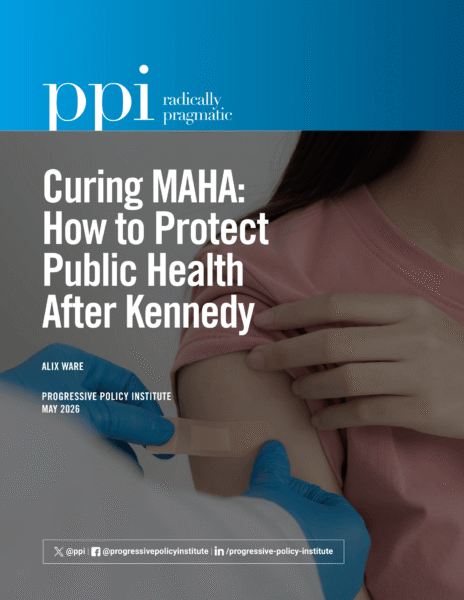
New PPI Report Details RFK Jr.’s Record of Breaking Health Promises

WASHINGTON (May 28, 2026) — The Progressive Policy Institute (PPI) released a new report today documenting how Health and Human Services Secretary Robert F. Kennedy Jr. has dismantled scientific safeguards and broken commitments to Congress, undermining legitimate efforts to improve America’s public health.

Curing MAHA: How to Protect Public Health After Kennedy,” authored by PPI’s Director of Health Care Policy Alix Ware, reveals how, instead of creating a credible public health initiative, Kennedy has exploited the fears of Make America Healthy Again supporters to advance discredited medical theories and consolidate power without oversight.

Kennedy promised Republican senators during his confirmation hearing that he would respect the government’s existing vaccine safety system and follow accepted science. Instead, the report documents how he has systematically removed scientific experts from key agencies, defunded critical medical research, and altered health guidance based on unfounded claims about autism, all while cutting nearly a quarter of the HHS workforce.

The damage extends across three critical areas:

  • Kennedy endorsed the reckless decimation of federal health agencies, eliminating staff who collect and analyze national health data and ethics professionals.
  • Kennedy has divorced health guidance from science, peddling long-debunked theories about vaccines and autism that have already influenced medication use among pregnant women.
  • Kennedy has removed oversight mechanisms designed to ensure agency decisions rest on evidence rather than ideology, firing the CDC director who resisted his demands and stacking federal advisory committees with vaccine skeptics.

“Many Americans have legitimate concerns about our health system that deserve serious attention,” said Ware. “But Kennedy’s approach has squandered an opportunity to address them. He promised to follow gold standard science and instead has weaponized federal health agencies to serve his personal beliefs.”

Even supporters of MAHA’s original goals are disappointed. Polling shows 47% of voters who backed the movement say the administration has not done enough to make America healthy again. Kennedy’s actions have eroded public trust in federal health guidance: confidence in the CDC’s vaccine schedule has fallen from 71% to 61% in under a year.

The report recommends that Congress take four steps to repair the damage and prevent similar abuses in the future:

  1. Increase transparency and accountability of federal advisory committees to ensure decisions are based on scientific evidence.
  2. Modernize the federal workforce while rebuilding trust with career employees so that skilled scientists and health professionals are not afraid to work in government.
  3. Limit the use of acting officials to prevent political appointees from bypassing Senate confirmation and accountability.
  4. Develop a long-term, non-partisan plan to address chronic disease grounded in evidence and expertise rather than shifting with each administration.

Read and download the report here.

Founded in 1989, PPI is a catalyst for policy innovation and political reform based in Washington, D.C. Its mission is to create radically pragmatic ideas for moving America beyond ideological and partisan deadlock. Find an expert and learn more about PPI by visiting progressivepolicy.org. Follow us at @ppi.

###

Media Contact: Ian O’Keefe – iokeefe@ppionline.org


Curing MAHA: How to Protect Public Health After Kennedy

INTRODUCTION

When President Trump nominated Robert F. Kennedy Jr. to become his secretary of health and human services, it was possible to conjure a few faint reasons for optimism. Yes, his well-known rejection of mainstream vaccine science and general penchant for medical quackery were frightening. But Kennedy also offered one fundamentally correct critique of America’s health approach: For years, we have done far too little to combat our country’s epidemic of chronic disease through prevention, instead relying on expensive treatments once people become sick.

To win confirmation, Kennedy gave some ground to his skeptics, promising Republican senators he would respect the government’s existing vaccine recommendation system and follow accepted science. Once in the cabinet, Kennedy’s Make America Healthy Again (MAHA) agenda was kicked off with the president signing an executive order vowing to tackle chronic illness through “fresh thinking on nutrition, physical activity, healthy lifestyles, over-reliance on medication and treatments, the effects of new technological habits, environmental impacts, and food and drug quality and safety.” On paper, all of these were worthy goals. If Kennedy had stuck to them in a remotely reasonable way, it was conceivable he might even have found bipartisan buy-in for parts of his MAHA agenda.

Unfortunately, Kennedy’s tenure at HHS has confirmed the worst concerns of his critics, and then some. He has thrown America’s major health agencies into turmoil by firing highly experienced scientists and health professionals, defunding vital medical research, and making unfounded claims about autism, all while emulating President Trump by ignoring checks and balances on his authority. His fixation on voodoo science and conspiracy theories is wasting the opportunity he had to make progress on a MAHA agenda that the country could overwhelmingly support.

In recent months, the Trump administration has made moves seemingly aimed at reining Kennedy in, due to the sheer unpopularity of his stances on issues like vaccines. Some Republican members of Congress have also started to push back against the secretary. But a new Congress will bring additional opportunities to hold him accountable for his record of broken promises. In this paper, we will review the most damaging aspects of the secretary’s record in depth, while outlining steps lawmakers should take to curb his abuses and prevent similar ones in the future. Those include:

  • Increasing the transparency and accountability of federal advisory committees
  • Modernizing the federal workforce while rebuilding trust with potential career employees
  • Limiting the use of acting officials for Senate-confirmed roles
  • Creating a long-term non-partisan plan to make America healthy

While curtailing the secretary’s destructive overreach is essential, it would be a mistake to ignore the genuine grassroots political energy the MAHA movement has harnessed. Many of its goals command overwhelming support among voters, at least when framed in general terms. Rather than attempt to return to the old status quo of health, critics would be wise to divorce Kennedy from the concerns of MAHA champions and point out how Kennedy’s own management of HHS is foiling the ambitions he vowed to pursue. America’s legions of MAHA supporters have some valid concerns about our health system. But they need a different sort of champion.

Read the full report.


U.S. layoffs are up for four consecutive years

FACT: U.S. layoffs are up for four consecutive years.

THE NUMBERS: Annual U.S. layoffs*

2025 21.2 million
2024 20.0 million
2023 19.9 million
2022 17.6 million
2021 17.1 million
2020 (pandemic year) 40.8 million
2015-2019 average 21.7 million

Bureau of Labor Statistics, Job Openings and Labor Turnover survey.

WHAT THEY MEAN: 

An idea for the next Congress, floated four years ago by then-PPI Workforce Policy Development Director Taylor Maag and Ed Gresser, and still good now: revive the Trade Adjustment Assistance program, but open it to everyone.

As an entry point, the Raleigh News & Observer has a stark lede last week:

“American tiremaker Goodyear Tire & Rubber plans to shut its long-running Fayetteville plant and eliminate approximately 1,700 jobs in what would be one of the biggest factory closures by employment loss in recent North Carolina history. Goodyear announced this week it is talking with the local workers’ union to end site operations by December 2027.” 

Not only North Carolina’s largest recent factory closure, this event appears to be the largest U.S. mass factory layoff outside the processed-food business in the 15 years since the end of the financial crisis. To put the impact in context, Metro Fayetteville is home to about 390,000 people, with the Goodyear plant joining a Wal-Mart distribution center and the local hospital as the top private-sector employer. Goodyear’s press comment cites short-term cost issues and lower consumer demand for tires; its quarterly earnings calls cite a loss of $420 million this year to “inflation, tariffs, and other costs” as a complementary challenge. (See Eric Boehm in Reason for a close look at the event, and analysis of the impact of tariffs and the Iran war’s interruption of petrochemical stocks for synthetic rubber.)

This particular closure comes in a larger environment in which layoffs are not at extreme highs, but have risen for five years in a row. According to the Bureau of Labor Statistics’ “Job Openings and Labor Turnover survey, last year’s 21.2 million layoffs were the largest annual total since the Covid pandemic in 2020, and about equal to the rates of the 2010s. To put this aggregate figure in human perspective, each day about 161 million Americans go to work, and about 60,000 come home with pink slips.

Their standard support program, unemployment insurance, provides a post-layoff stipend of up to 26 weeks in some states as they look for the next job. From 1962 through the summer of 2022, though, the smaller “Trade Adjustment Assistance” program offered a much broader range of options to those dislocated workers who could show that import competition or job shifts overseas “contributed importantly to [their] separation or threat of separation.” Background on this:

Origins and benefits: President John F. Kennedy launched “TAA” in 1962, as a complement to his very ambitious trade-liberalizing and tariff-cutting bill. By 2015, when TAA got the last of its 18 renewals and upgrades, it had evolved into a sort of pilot program in active labor-market policy, offering a menu of self-help options appropriate to workers with widely differing career goals and local options: two years of job training for those seeking a new career path; temporary wage insurance for older workers taking lower-paying jobs; health care tax credits; and relocation support for workers planning to move to areas with more employment opportunities. Examining the results in 2018, New York Fed researcher Ben Hyman found strong benefits for workers and a useful concentration of benefits in regions with particularly high needs:

“Ten years out, TAA-trained workers have $50,000 higher cumulative earnings, driven by both higher incomes and greater labor force participation. Yet annual returns fully depreciate after ten years. … Returns are further concentrated in the most disrupted regions.”

Small scale and structural limits: TAA didn’t, though, actually serve many workers. From 2014 to 2018, according to the DoL’s annual reports, about 85,700 displaced workers a year got TAA benefits. This would be about 0.5% of the era’s 21.6 million annual layoffs. Modest use isn’t per se a problem — lots of workers find jobs after layoffs and don’t require extra support — but the limitation imposed by TAA’s tie to trade competition made it hard to get. Since eligibility depended on proving imports or job shifts overseas “contributed importantly” to the layoff, most workers — health sector, retail, gas stations, beauty parlors, government agencies — weren’t eligible at all. And though “contributed importantly” isn’t in principle a very high bar, in practice, it created a big obstacle by requiring workers in distress to find the statistics and economic analysis necessary to demonstrate eligibility.

And a core question: The TAA concept also, as Gresser and Maag noted in 2022, had a “troubling inequity” at its core:

Workers who lose jobs to trade competition can get more generous benefits than workers who lose jobs to recession or domestic competition.  Is there really a strong ethical case to distinguish between (say) a displaced clothing factory worker and a displaced waitress or gas station attendant, and view the former as more in need of benefits or more entitled to benefits than the latter? 

With the program then on the verge of lapsing, they urged Congress to renew it, but drop the trade requirement and offer TAA-type benefits to all workers displaced through no fault of their own. Subsequent events — events such as the Goodyear factory closure, where U.S. tariff increases rather than import competition are likely the “important contributor,” or the broader acceleration of technological change and outmoding of particular skills or industries — only add force to the conclusion. Congress regrettably didn’t act then, and TAA has lapsed for four years. The new Congress arriving next January, or the early-stage presidential campaigns launching around that time, can take it up now.

FURTHER READING

PPI’s New Skills for a New Economy project, with Michael Pearson as Director, has an analysis of a robust workforce development system that is fully-funded, modern, industry-responsive, and equips current and future workers with the skills they need to get ahead.

Gresser and Maag (2022) on re-authorizing Trade Adjustment Assistance, but opening it to everyone. Their estimate was that such a program would serve about a million displaced workers annually, at a cost of about $6 billion per year.

… and follow Maag’s work at Jobs for the Future.

Layoffs:

The Raleigh News & Observer reports on Goodyear’s Fayetteville factory closing announcement.

Eric Boehm in Reason takes a close look at the events, and the impact of tariffs and war.

And the Bureau of Labor Statistics’ Job Openings and Labor Turnover survey (most recent release here; and database here) puts individual events in the context of national job openings, new hires, layoffs, quits, and retirements.

TAA data and status:

The Labor Department’s TAA database, with counts of petitions and worker certifications from 2010 forward.

… and DoL’s formal Annual Reports on TAA from 2009 to the lapse in 2022.

An evaluation from Ben Hyman of the New York Fed, 2018.

And a Ways and Means Committee renewal hearing featuring workers, firm owners, and state officials, 2021.

ABOUT ED

Ed Gresser is Vice President and Director for Trade and Global Markets at PPI.

Ed returns to PPI after working for the think tank from 2001-2011. He most recently served as the Assistant U.S. Trade Representative for Trade Policy and Economics at the Office of the United States Trade Representative (USTR). In this position, he led USTR’s economic research unit from 2015-2021, and chaired the 21-agency Trade Policy Staff Committee.

Ed began his career on Capitol Hill before serving USTR as Policy Advisor to USTR Charlene Barshefsky from 1998 to 2001. He then led PPI’s Trade and Global Markets Project from 2001 to 2011. After PPI, he co-founded and directed the independent think tank ProgressiveEconomy until rejoining USTR in 2015. In 2013, the Washington International Trade Association presented him with its Lighthouse Award, awarded annually to an individual or group for significant contributions to trade policy.

Ed is the author of Freedom from Want: American Liberalism and the Global Economy (2007). He has published in a variety of journals and newspapers, and his research has been cited by leading academics and international organizations including the WTO, World Bank, and International Monetary Fund. He is a graduate of Stanford University and holds a Master’s Degree in International Affairs from Columbia Universities and a certificate from the Averell Harriman Institute for Advanced Study of the Soviet Union.

Read the full email and sign up for the Trade Fact of the Week.

Manno for Merion West: The Social Wealth Men Without College Degrees Need

“So as the college degree has increasingly become the great sorting function in American life, men without degrees have increasingly found themselves sorted out,” write the authors of Nobody to Call, a new report on friendship, community, and purpose among men without college degrees.

These men did not become disconnected from work, friendship, and community all at once. That separation unfolded slowly, as they lost touch with the people and institutions that build a stable life.

A man leaves high school without a clear next step. Daily routines vanish and friends scatter. As work becomes unstable, he finds no mentors to offer support and no community institutions to which he can turn. The young man who was once merely uncertain slowly becomes an adult man without connections.

Read more in Merion West