
WASHINGTON (May 12, 2026) — A new report from the Progressive Policy Institute (PPI) finds that expanding advanced recycling at existing oil refineries and new standalone facilities nationwide can more than double the U.S. plastic recycling rate from 9% to between 19-23%.
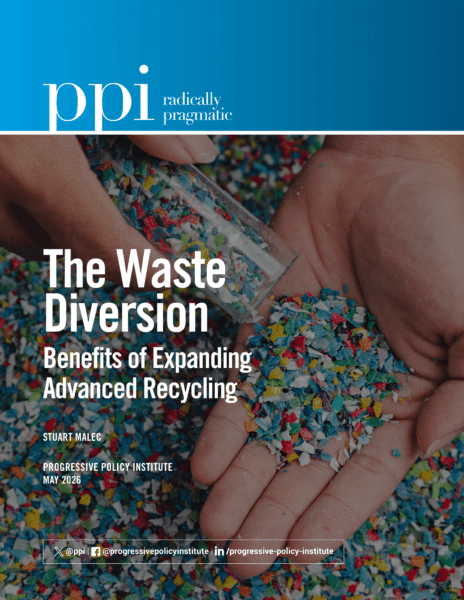
Authored by Stuart Malec, PPI’s Vice President of Public Affairs, “The Waste Diversion Benefits of Expanding Advanced Recycling,” outlines how traditional mechanical recycling is limited due to its inability to recycle ‘flexible plastics’ such as shopping bags and plastic films or plastics contaminated by food or oil residue. Advanced recycling, which uses chemical processes like pyrolysis to break plastics down to the molecular level, can fill in the gap and convert plastic waste into raw materials that can be used to make new products.
“Scaling up advanced recycling efforts will lead to significant environmental and economic benefits,” said Malec. “Increasing the amount of plastic waste that can be successfully recycled will not only benefit the planet, but will also collectively save communities across the country millions of dollars in their waste disposal budgets.”
Key findings from the report include:
While advanced recycling can curb dangerous environmental effects and benefit local economies, Malec argues that there needs to be a regulatory framework that strengthens the economic incentives to collect plastic waste.
“Clear policy is essential for this innovative technology to achieve its full potential in waste diversion and economic impact,” said Malec. “Without a clear policy framework, more and more plastic waste will continue ending up in landfills instead of being reused in the economy.”
Read and download the report here.
Founded in 1989, PPI is a catalyst for policy innovation and political reform based in Washington, D.C. Its mission is to create radically pragmatic ideas for moving America beyond ideological and partisan deadlock. Find an expert and learn more about PPI by visiting progressivepolicy.org. Follow us at @ppi.
###
Media Contact: Ian O’Keefe – iokeefe@ppionline.org

