Advanced Recycling Could More Than Double U.S. Plastic Recycling Rates, New PPI Report Shows

WASHINGTON (May 12, 2026) — A new report from the Progressive Policy Institute (PPI) finds that expanding advanced recycling at existing oil refineries and new standalone facilities nationwide can more than double the U.S. plastic recycling rate from 9% to between 19-23%.

Authored by Stuart Malec, PPI’s Vice President of Public Affairs, “The Waste Diversion Benefits of Expanding Advanced Recycling,” outlines how traditional mechanical recycling is limited due to its inability to recycle ‘flexible plastics’ such as shopping bags and plastic films or plastics contaminated by food or oil residue. Advanced recycling, which uses chemical processes like pyrolysis to break plastics down to the molecular level, can fill in the gap and convert plastic waste into raw materials that can be used to make new products.

“Scaling up advanced recycling efforts will lead to significant environmental and economic benefits,” said Malec. “Increasing the amount of  plastic waste that can be successfully recycled will not only benefit the planet, but will also collectively save communities across the country millions of dollars in their waste disposal budgets.”

Key findings from the report include:

  • Short-term deployment of advanced recycling could raise the nationwide plastic recycling rate from 9% to 19% while potentially reaching 23% in the long-term.
  • Local municipalities could save between $229.7 million-$327.5 million per year in avoided landfill tipping fees, defined as charges per ton to dispose of waste.
  • States with historically low recycling rates can use existing oil refineries to implement advanced recycling technology, raising their landfill diversion rates.

While advanced recycling can curb dangerous environmental effects and benefit local economies, Malec argues that there needs to be a regulatory framework that strengthens the economic incentives to collect plastic waste.

“Clear policy is essential for this innovative technology to achieve its full potential in waste diversion and economic impact,” said Malec. “Without a clear policy framework, more and more plastic waste will continue ending up in landfills instead of being reused in the economy.”

Read and download the report here.

Founded in 1989, PPI is a catalyst for policy innovation and political reform based in Washington, D.C. Its mission is to create radically pragmatic ideas for moving America beyond ideological and partisan deadlock. Find an expert and learn more about PPI by visiting progressivepolicy.org. Follow us at @ppi.

###

Media Contact: Ian O’Keefe – iokeefe@ppionline.org

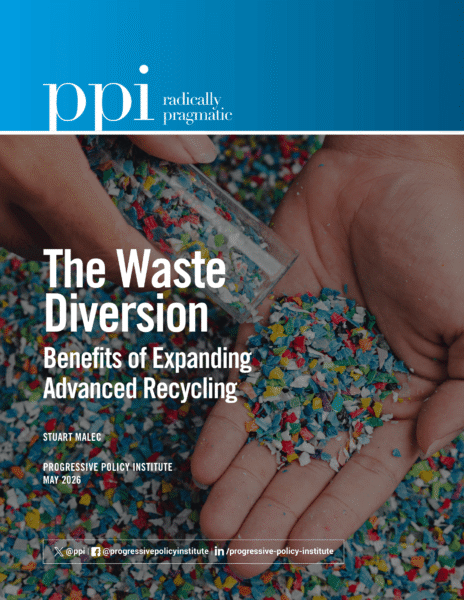
The Waste Diversion Benefits of Expanding Advanced Recycling

Advanced recycling offers a unique potential solution to the problem of plastic waste. Conventional mechanical recycling is limited by technological and logistical issues, particularly the inability to process plastic waste contaminated by food or oil residue. Mechanical recycling is also not designed to recycle the millions of tons of flexible plastics (e.g., shopping bags and plastic films) generated each year, which means those plastic products must be sent to landfills. Existing recycling initiatives have shown promise, but not at the scale required to meaningfully reduce the amount of plastic waste that ends up in landfills.

A distinct advantage of advanced recycling over mechanical recycling is that, through chemical processes like pyrolysis, advanced recycling facilities can reduce plastics down to the molecular level. This means that a broader range of plastics, including flexible plastics, can be recycled at advanced recycling facilities compared to mechanical ones. Advanced recycling facilities are complementary to existing mechanical recycling facilities: together, both types of facilities form an “all-of-the-above” solution to recycling plastic waste.

In addition to broadening the types of plastic materials that can be recycled, advanced recycling expands the geographical extent of recycling efforts. Advanced recycling technology can be added to oil refineries, integrating plastic waste into their processes as a feedstock. Many existing oil refineries are located in states that historically have had low recycling rates, such as Louisiana, which currently has an estimated total plastic recycling rate of just 6%.

Advanced recycling could deliver economic benefits to municipalities beyond the benefits of plastic waste diversion. Landfills charge a “tipping fee” per ton of waste collected. Because recycling diverts plastic waste away from landfills, advanced recycling could save between $230 million and $328 million in tipping fees per year for municipalities across the U.S. For example, Los Angeles County, CA, could save between $3 to $6 million in tipping fees while Harris County, TX, could save up to $22 million.

Despite the potential environmental and economic benefits of advanced recycling technology, the advanced recycling industry lacks the regulatory framework necessary for a robust market for plastic waste to form. Absent strong economic incentives to collect, sort, and transport waste to advanced recycling facilities, the scale of the industry and its realized benefits will be constrained.

Read the full report.

Illinois’ Energy Leadership at Risk Without a Pragmatic Climate Strategy, New PPI Report Warns

WASHINGTON (April 21, 2026) — A new report from the Progressive Policy Institute (PPI) finds that Illinois has built one of the nation’s cleanest and most affordable energy systems, but warns that calendar-driven mandates to phase out natural gas generation could undermine grid reliability, drive up costs, and push investment to neighboring states.

Authored by Neel Brown, Managing Director at PPI, and John Kemp, an internationally recognized energy markets expert, “The Illinois Challenge: Balancing Decarbonization with Economic Reality,” outlines a strategy grounded in reliability, technological maturity, and economic competitiveness.

Illinois has reduced emissions faster than the national average, driven largely by its dominant nuclear fleet and a steady, market-led shift from coal to natural gas. Emissions fell 2.1% annually between 2005 and 2023, compared to 1.2% nationwide, and the state now emits 188 tons of carbon dioxide per $1 million of economic output, more than 10% below the national average and well below every other Midwest state. Household energy spending is nearly 12% below the national average, underscoring the affordability gains that have sustained public support for continued climate progress.

“Illinois’ progress shows that durable emissions reductions come from markets, innovation, and firm low-carbon generation, not from rigid calendar deadlines,” said Brown. “The state already leads the country in clean nuclear power. The next phase requires a pragmatic strategy that protects reliability and affordability while continuing to drive emissions down.”

The authors note that the 2021 Climate and Equitable Jobs Act mandates a full phaseout of natural gas generation by 2045, a timeline that the state’s own 2025 Resource Adequacy Study warns could open significant capacity gaps just as electricity demand is surging. Illinois is currently the country’s fifth-largest electricity generator and a net exporter, but eliminating in-state gas generation is projected to turn it into a net importer reliant on the PJM and Midcontinent Independent System Operator (MISO) regional grids, both of which are expected to face capacity shortfalls by 2030.

Upward pressure on prices is already emerging. Wholesale electricity costs in the PJM region serving northern Illinois surged more than 40% in 2025 amid rapid data center growth, and residential rates jumped 11% in a single year. The authors caution that retiring firm generation before proven replacements are in place will pull energy-intensive industries to higher-emission states such as Indiana and Ohio, exporting both jobs and carbon emissions. Illinois Gov. JB Pritzker has taken a constructive step by committing to two gigawatts of new nuclear generation and lifting the state’s longstanding moratorium on new reactor construction, reflecting the kind of pragmatic, state-specific policymaking the report recommends.

To navigate this transition, the authors outline three core principles for policymakers:

  1. Embrace new nuclear as the foundation of a clean, firm electricity system capable of supporting 24/7 industrial loads and backstopping intermittent renewables.
  2. Reform gas transition timelines so infrastructure retirements are aligned with the proven readiness of replacement technologies rather than calendar deadlines.
  3. Prioritize grid reliability by heeding regional capacity warnings and avoiding policies that risk blackouts, price spikes, or the loss of in-state generation.

The authors conclude that Illinois’ path to decarbonization must reflect its unique position as the nation’s top nuclear producer and a major electricity exporter. A successful strategy will build on the state’s market-driven progress while avoiding mandates that risk destabilizing the grid, raising costs for households and businesses, or pushing investment across state lines.

Read and download the report here.

Founded in 1989, PPI is a catalyst for policy innovation and political reform based in Washington, D.C. Its mission is to create radically pragmatic ideas for moving America beyond ideological and partisan deadlock. Find an expert and learn more about PPI by visiting progressivepolicy.org. Follow us at @PPI.

###

Media Contact: Ian O’Keefe – iokeefe@ppionline.org

The Illinois Challenge: Balancing Decarbonization with Economic Reality

A LEGACY OF PRAGMATIC SUCCESS

Historically, Illinois has operated from a position of strength in the energy market with a low-carbon foundation that other states are only beginning to strive toward. However, policies that are aimed at abolishing current dispatchable generation to meet climate goals set in 2021 threaten to undermine the state’s energy and economic successes.

Illinois’ per-person energy consumption is close to the national average (see fig. 1), but greenhouse gas emissions are well below (see fig. 2) thanks to its status as the country’s top generator of nuclear power — the state’s largest source of electricity. Coal use has gradually shrunk; gas overtook it as the second-largest source of power in 2023 (see fig. 3) while wind generation has doubled in just seven years and is on course to move up to third place. Total spending per person on electricity, gas, and gasoline is among the lowest in the country, at almost 12% below average (see fig. 4). Economic output per person is high, and as a result, total energy spending accounts for just 4.7% of state output, more than 16% below average.

Illinois has also been more successful than most other states at lowering emissions in recent decades, cutting them 2.1% per year between 2005 and 2023, compared to 1.2% for the country as a whole. The state achieved this speedy reduction mostly because gas replaced coal-fired generation while its population stayed flat.

Compared to the size of its economy, Illinois’ carbon emissions are now the 18th-lowest in the U.S.; it produced 188 tons for every $1 million of output in 2023 (see fig. 5), down 42% since 2005 after adjusting for inflation, and more than 10% below the national average. Illinois emits much less CO₂ per $1 million of output than other Midwest states, including Minnesota (207 tons), Wisconsin (250 tons), Michigan (255 tons), Ohio (260 tons), Missouri (291 tons), Iowa (337 tons), and Indiana (381 tons). It performs well on this measure thanks to the local dominance of high-value-added, low-energy-use industries such as finance and insurance, as well as significant nuclear output.

Illinois is the country’s fifth-largest electricity generator and exports surplus power to neighboring states. In 2024, it was by far the country’s largest nuclear producer (99 billion kilowatt-hours), well ahead of second-place Pennsylvania (75 billion kWh). Nuclear accounted for more than half of in-state generation. Fossil fuels accounted for 31% of generation in 2023, down from 51% in 2005. Coal generation has been cut by two-thirds, mostly replaced by equal amounts of wind and gas. As a result, its energy mix has the country’s fifth-lowest carbon intensity (see fig. 6). Nonetheless, residual coal generation is among the highest in the country, which explains why Illinois has not made even faster progress reducing emissions.

Read the full report. 

After Early Emissions Gains, Pennsylvania Faces Tough Tradeoffs on Climate, Cost and Reliability, PPI Finds

WASHINGTON — A new report from the Progressive Policy Institute (PPI) finds that Pennsylvania has made significant progress reducing carbon emissions while maintaining energy affordability, but warns that the next phase of decarbonization will be more complex, costly, and politically challenging. Authored by Neel Brown, Managing Director at PPI, and John Kemp, an internationally recognized energy markets expert, “Pennsylvania’s Energy Crossroads: Charting a Pragmatic Path to Decarbonization,” outlines a strategy grounded in economic reality, technological flexibility, and energy reliability.

Pennsylvania has reduced emissions faster than the national average, largely due to a market-driven shift from coal to natural gas. Emissions fell from 276 million metric tons in 2005 to 201 million in 2023, a decline of 1.9% annually compared to 1.2% nationwide. At the same time, energy costs for residents remain below the national average, underscoring the importance of affordability in sustaining public support for climate action.

“Pennsylvania’s progress shows that durable emissions reductions are most effective when driven by markets and innovation, not rigid mandates,” said Brown. “The state has already captured the ‘low-hanging fruit’ of decarbonization. The next phase will require a more pragmatic strategy that balances climate ambition with economic competitiveness.”

The authors highlight that Pennsylvania’s emissions profile has shifted significantly. The industrial sector is now the largest source of emissions, followed by transportation and then electric power, which has already seen substantial reductions. This shift requires policymakers to rethink priorities and focus on sectors that are harder to decarbonize.

The authors also note that Pennsylvania’s electricity system remains heavily dependent on natural gas and nuclear power, which together provide a stable and affordable energy foundation. However, rising demand from data centers and capacity constraints in the Pennsylvania-New Jersey-Maryland region are beginning to put upward pressure on electricity prices, signaling new challenges ahead. Pennsylvania Gov. Josh Shapiro has proposed ambitious legislation to continue reducing emissions, but on a path that is more suitable to Pennsylvania’s unique energy profile. This approach reflects the kind of pragmatic, state-specific policymaking the report recommends.

To navigate this transition, the authors outline three core principles for policymakers:

  1. Leverage existing energy assets by maintaining and optimizing natural gas and nuclear power as foundational sources of reliable, dispatchable energy
  2. Focus on outcomes rather than mandating specific technologies, encouraging innovation across a range of low-carbon solutions
  3. Ensure climate policies do not undermine economic competitiveness or increase costs for households and businesses
The authors conclude that Pennsylvania’s path to decarbonization must reflect its unique economic structure as a major energy producer and industrial state. A successful strategy will build on past market-driven successes while avoiding policies that risk destabilizing energy prices or grid reliability.
Read and download the report here.
Founded in 1989, PPI is a catalyst for policy innovation and political reform based in Washington, D.C. Its mission is to create radically pragmatic ideas for moving America beyond ideological and partisan deadlock. Find an expert and learn more about PPI by visiting progressivepolicy.org. Follow us @ppi.

###

Media Contact: Ian OKeefe – iokeefe@ppionline.org

Pennsylvania’s Energy Crossroads: Charting a Pragmatic Path to Decarbonization

BALANCING INDUSTRIAL HERITAGE WITH CLIMATE AMBITION 

Pennsylvania stands as a pivotal state in the American energy landscape, defined by a deep heritage as a major producer and consumer of fossil fuels. This legacy has powered its industries and communities for generations, but it also presents a formidable challenge in an era of accelerating climate change. Pennsylvania is therefore confronted with a defining question:  how to reconcile its climate ambitions with the economic realities of its industrial base and the affordability needs of its citizens, a tension that can only be resolved through pragmatism. 

ENERGY CONSUMPTION AND EMISSIONS 

Pennsylvania’s energy consumption and emissions per person are close to the national average, according to data from the U.S. Energy Information Administration (see Fig. 1). Coal fired generation has been cut by 90% since 2005, with nearly all electricity now coming from gas  and nuclear, reducing emissions from the power sector (see Fig. 2). Residential electricity prices are slightly above average, but consumption is well below, keeping bills in check. Total energy  spending per person on electricity, gas, and gasoline is about 5% below the national average  (see Fig. 3). But like other states in the PJM Interconnection, growing demand from data centers  and capacity shortages are putting upward pressure on power prices. 

Pennsylvania’s total emissions rank in line (4th) with its population (5th) and the size of its economy (6th). But the state has been more successful than most in lowering them: Emissions were cut to 201 million metric tons in 2023 from 276 million in 2005. The decline was significantly faster (1.9% per year) than the country as a whole (1.2% per year), mostly because gas has replaced coal-fired electricity generation while population growth has been slow.  

Emissions are relatively high given the size of the economy. Pennsylvania’s principal economic activities are finance, insurance, real estate, and professional and business services, which are not energy intensive. But chemicals, oil and gas extraction, mining, food manufacturing, metals,

and machinery are also significant and use far more energy. The state emitted 251 tons for  every $1 million of output in 2023, down from 450 tons in 2005, after adjusting for inflation.  Emissions per $1 million of output were the 23rd highest in the country and well above the  

national average (211 tons). Pennsylvania emits almost three times as much COas New York and twice as much as Connecticut to produce the same amount of economic output.  

The state has made slightly faster progress than most others in reducing the carbon intensity of its energy system (see Fig. 4). Fossil fuels accounted for 78% of primary energy consumption in  2023, down only marginally from 81% in 2025, but there has been a shift to lower-emission gas from oil and especially coal. As a result, Pennsylvania emitted 46 metric tons of COfor every 1  

billion British thermal units of energy supplied in 2023, down from 61 tons in 2005. Carbon  intensity was well above low-carbon leaders Vermont (38 tons), New Hampshire (39 tons), and  South Carolina (40 tons), but 9% below the national average (51 tons). 

Pennsylvania is the country’s third-largest electricity generator (after Texas and Florida), and it  exports more surplus power to neighboring states than any other. Fossil fuels accounted for  65% of generation in 2023, a slight increase from 63% in 2005. But coal-fired generation has  been slashed by 90%, replaced by lower-emission gas. Fossil fuels retained their market share for two reasons: First, while the state remains the second-highest nuclear generator in the country after Illinois, production from that source has remained flat over time. Meanwhile,  renewable growth has been slow: The state uses little hydro, wind, or solar power, with them  accounting for just 4% of its electricity generated in 2023.  

Pennsylvania’s energy consumption is in line with the national average, making the state something of a bellwether. Consumption per person (277 million BTUs) was indistinguishable from the national average (278 million BTUs) in 2023. But energy efficiency is low. Energy consumption per $1 million of output was 9% above the national average. Since 2005, the state  has been falling further behind, with consumption per unit of output declining more slowly (1.9%  per year) than across the country as a whole (2.2% per year).  

Read the full report.

PPI Finds Latino Families Bear Disproportionate Burden from High Energy Costs

WASHINGTON — Latino families across the United States are disproportionately affected by high energy costs, according to a new report from the Progressive Policy Institute (PPI). The study, “Working Latinos Need Relief from High Energy Costs,” finds that Latino households are nearly twice as likely as white households to experience energy insecurity, defined as difficulty affording energy or maintaining a safe household temperature.

Authored by Elan Sykes, Director of Energy and Climate Policy at PPI, the report highlights how infrastructure gaps, outdated housing, and inefficient appliances drive up energy burdens for working-class Latino communities in both urban and suburban areas. Using case studies from Los Angeles and Boston, the analysis reveals that Latino-majority neighborhoods often lack access to clean, affordable energy due to slow permitting processes and underinvestment in modern grid infrastructure.

“Energy policy too often ignores the daily struggles of working families,” said Sykes. “While many Latino Americans support clean energy, they make decisions based on cost, and current policies leave them paying more for less.”

PPI’s report argues for a shift in environmental justice priorities to include cost, access, and infrastructure alongside climate concerns. The study offers a forward-looking blueprint for energy fairness, including:

  • A balanced, technology-neutral energy mix including renewables, nuclear, and low-methane natural gas
  • Expedited permitting reforms to accelerate grid and pipeline upgrades.
  • Expansion of federal assistance programs like the Low-Income Home Energy Assistance Program (LIHEAP) and the Weatherization Assistance Program (WAP)
  • Creation of local Community Energy Hubs to connect residents with information and support
  • Neighborhood investment in energy-efficient housing, tree cover, and transit options
The report also criticizes overly restrictive policies that delay or block infrastructure needed for grid reliability, noting that opposition to new substations and pipelines has often left low-income neighborhoods with higher bills and more pollution.

“For Latino Americans, cost of living is a top priority. Any successful climate strategy must recognize that affordability is essential to sustainability,” said Sykes.

PPI polling shows that 69% of working-class Latino respondents base energy decisions on cost, not carbon footprint, underscoring the need for pragmatic solutions that deliver both economic and environmental benefits.

Read and download the report here.

Founded in 1989, PPI is a catalyst for policy innovation and political reform based in Washington, D.C. Its mission is to create radically pragmatic ideas for moving America beyond ideological and partisan deadlock. Find an expert and learn more about PPI by visiting progressivepolicy.org. Follow us @ppi.

###

Media Contact: Ian OKeefe – iokeefe@ppionline.org

Working Latinos Need Relief from High Energy Costs: Data by State

In the scatter plots for each state, every panel reflects the relationship between the Latino population and energy burdens in one Congressional District in that state. Within each district’s panel, one dot represents each census tract in that district. The slope of each panel’s light blue line reflects the correlation between a higher Hispanic population and higher energy burdens for that district, with its confidence interval shown in gray (so a wider gray shading represents a looser fit for that panel’s blue line). Then, each Congressional District in the states included in PPI’s reportWorking Latinos Need Relief from High Energy Costs is mapped such that the fill color of each census tract scales according to the energy burden as a percent of area median income or the proportion of Hispanic households as a share of the tract’s population.

This appendix uses data from the Department of Energy’s Low-income Energy Affordability Data (LEAD) tool collected through the Census Bureau. Importantly, these estimations are not causal and only reflect the statistical level of similarity between the two characteristics across the range of census tracts in each district. Additionally, the underlying data report values for energy burden calculated from area median income and average annual energy costs, and so do not capture varying levels of energy burden within each tract or microdata like individual household burden. Even though this correlation does not allow for direct causal claims, the simplicity of this comparison provides significant insight when paired with the entire PPI report.

Each state listed below links to a PDF with this data, in both English and Spanish:

Read the full report in English and Spanish.


Working Latinos Need Relief from High Energy Costs

Click here for State by State data.

EXECUTIVE SUMMARY

The November 2025 off-year elections confirmed that the cost of living is still top of mind for U.S. voters. High energy costs, for example, figured prominently in contests in Virginia, New Jersey, and New York. The issue affects all Americans, of course, but puts especially heavy financial burdens on low-income and working-class communities. Many urban Latino families, for example, pay higher energy costs than more affluent surrounding neighborhoods. This report, the second in a series of PPI studies of energy insecurity in America, examines the reasons for this disparity.

It finds that Latinos are twice as likely as their white counterparts to experience energy insecurity. This connotes difficulty in accessing or paying for energy, the hard choices they face between paying fuel bills and meeting other pressing needs, and consequently, the higher risk of utility cut-offs. As PPI has previously documented, working-class Black neighborhoods also face higher energy burdens than surrounding suburbs. We believe these disparities deserve more attention from U.S. energy policymakers.

Building on our study of high energy burdens in Black neighborhoods in Boston, this report explores the same phenomenon in working-class Latino communities of Massachusetts, including Boston, as well as the city of Los Angeles. We identify the lack of modern energy grid and pipeline infrastructure to supply all neighborhoods with affordable and abundant energy as the main cause of greater energy insecurity for working-class Latinos in Massachusetts and California.

These findings pose a challenge to “environmental justice” activists. While rightly stressing the health and environmental risks of pollution in low-income and minority communities, they have failed to focus on the economic costs and opportunities — job growth, innovation, investment, lower prices — of a balanced clean energy transition. What residents of low-income communities want most of all isn’t reparations for past injustice but equal access to affordable and reliable energy.

Latinos constituted 19.5% of the population and 10% of voters in 2024.1 They vary widely in national origin, socioeconomic status, and geographic distribution. A combination of low but rising average incomes and education levels, historical discrimination in employment and housing markets, and the lack of adequate electricity and energy infrastructure mean that many working-class Latino families have lower incomes, less efficient homes and appliances, and higher energy bills than college-educated Americans living in affluent suburbs. Barriers in language, limited financial resources, and poor infrastructure access mean that climate policies like the Inflation Reduction Act provided much less help to energy-burdened minority communities.

In PPI’s polling of working Americans, Latino voters broadly support action against climate change and a shift to clean energy resources, but make their decisions about energy based on cost. For them, high fuel bills are central to the broader cost-of-living crisis facing working Americans. To assuage this concern, U.S. policymakers should embrace smarter climate and energy policies that don’t threaten them with immediate fossil fuel bans that produce energy scarcity and higher prices.

Our report concludes with the following policy recommendations for shaping a new compact with working Americans on climate and energy, and ensuring that Latino communities don’t get left further behind:

  • A Balanced, Technology-Neutral Approach: Instead of unpopular and premature fossil fuel bans, policymakers should support an energy mix of nuclear, renewables, batteries, carbon capture, utilization, and storage (CCUS), and low-methane natural gas to ensure both emissions reductions and affordable energy.
  • Permitting Reform to Accelerate Clean Energy Deployment: Congress and state governments should streamline approval processes for renewable energy projects, grid expansion, and pipeline infrastructure to lower costs and improve reliability.
  • Targeted Energy Assistance for Low-Income Families: Congress should expand and modernize programs like the Low Income Home Energy Assistance Program (LIHEAP) and Weatherization Assistance Program (WAP) to better serve households struggling with high energy burdens.
  • Community Energy Hubs: Establishing local government centers where citizens can get information on energy efficiency, clean energy options, and financial assistance programs, modeled on Colorado’s resilience hubs and the federal government’s American Jobs Centers.
  • Affordable Housing and Improved Quality of Life: Many Latino households in urban, suburban, and rural communities across the country struggle to find affordable housing and are forced to settle for older, lower-quality housing options in polluted neighborhoods with inadequate power and clean water supplies.
  • Providing neighborhood amenities like trees, solar shading, strengthened electric distribution grids, and space for a variety of transportation modes would improve the quality of life for Hispanic families currently exposed to disproportionate pollution burdens and extreme weather in unaffordable or overcrowded homes.
    • Better Jobs, Indoors and Out: Many non-college Latinos hold outdoor jobs and jobs related to energy technologies, including construction, agriculture, and delivery logistics. As the American West is already feeling the impacts of climate change, giving firefighters the permits and resources they need to conduct proactive fire prevention measures would reduce health and climate impacts on outdoor workers and nearby cities. Offering guidance and technology incentives to protect against extreme heat exposure and other climate adaptation challenges to address problems relevant to workers’ daily lives.

Read the full report in English and Spanish.

New PPI Report Warns Virginia’s Energy Mandates Threaten Grid Stability and Affordability Amid Data Center Boom

WASHINGTON — The Progressive Policy Institute (PPI) today released a new report warning that Virginia’s rigid energy mandates are colliding with surging electricity demand from the state’s booming data center industry, creating a policy-induced risk to affordability and grid reliability that could undermine public support for climate progress. As demand accelerates and reliability pressures mount, the report finds that inflexible, technology-specific mandates are increasingly disconnected from economic and system realities.

The report, titled “The Virginia Challenge: Meeting Energy Demand Affordably,” is the third in a PPI series examining how rigid climate mandates and prescriptive technology requirements can threaten affordability and reliability when real-world energy demand and grid constraints are treated as secondary concerns.

“Virginia’s emissions success came from a pragmatic strategy that prioritized reliable, clean power,” said Neel Brown, Managing Director at PPI. “But the state is now forcing the retirement of the very resources that made that progress possible — just as electricity demand is exploding. When policy ignores reliability and affordability, the result is higher costs, greater risk, and eroding public support.”

Authored by Brown and John Kemp, an internationally recognized energy markets expert, the report finds that Virginia’s strong emissions record largely predates the Virginia Clean Economy Act and reflects a successful shift from coal to natural gas and nuclear power. The report warns that today’s rigid mandates, enacted before the data center boom, now risk delivering diminishing climate returns while increasing costs and reliability risks for households and businesses.

Despite this strong baseline, the state’s current energy strategy is increasingly strained by skyrocketing demand, capacity concerns, and mounting wholesale costs. With reliability and affordability at stake, Virginia faces a critical opportunity to recalibrate its approach before inflexible mandates erode both climate progress and public support.

Key findings from the report include:

  • Virginia’s electricity demand grew at an annual rate of 3.1% from 2019 to 2024 — more than triple the national average — driven primarily by the explosive growth of data centers in Northern Virginia, now the largest concentration in the world.
  • The Virginia Clean Economy Act mandates the retirement of nearly all natural gas and coal generation by 2045, even though gas and nuclear currently provide 87% of the state’s electricity and have been the main drivers of emissions reductions.
  • Despite this surge in demand, wind and solar together supplied only 7% of Virginia’s electricity in 2024, underscoring the gap between renewable targets and deployment reality.
  • Wholesale electricity costs in the PJM Interconnection region surged more than 40% in the first nine months of 2025, with capacity charges, paid to ensure grid reliability, tripling over the same period.
  • Virginia’s per capita emissions (10.8 tons) and carbon intensity per $1 million GDP (158 tons) are already well below the national average, reflecting pre-VCEA gains from replacing coal with lower-emission resources.
  • The VCEA’s rigid mandates, crafted before the data center boom, do not account for today’s demand realities, risking reliability shortfalls and rising costs if clean-firm power is retired prematurely.

The authors argue that inflexible technology mandates and statutory retirement deadlines, combined with a failure to adapt to rising demand, have created a structural risk to Virginia’s power grid. When affordability and reliability are overlooked, consumer costs rise, and support for climate action falters. The report urges policymakers to pivot toward outcome-based energy policy, expand clean-firm capacity, and treat affordability as a core indicator of climate policy success.
PPI’s analysis offers a roadmap for recalibrating Virginia’s strategy, emphasizing flexibility, reliability, and fairness, to maintain progress toward decarbonization while safeguarding the Commonwealth’s energy future.

Read and download the report here.

Founded in 1989, PPI is a catalyst for policy innovation and political reform based in Washington, D.C. Its mission is to create radically pragmatic ideas for moving America beyond ideological and partisan deadlock. Find an expert and learn more about PPI by visiting progressivepolicy.org. Follow us @ppi

###

Media Contact: Ian OKeefe – iokeefe@ppionline.org

The Virginia Challenge: Meeting Energy Demand Affordably

THE CHALLENGE OF BALANCING CLIMATE AMBITION WITH REALITY

Virginia’s energy policy is at a critical inflection point. The rigid, technology-specific mandates of the Virginia Clean Economy Act (VCEA), which legally commits the state to a 100% carbon-free electricity grid by 2045, are on a direct collision course with the skyrocketing energy demand from its world-leading data center industry. In 2020, this landmark legislation was enacted by a Democratic legislative majority on a mostly party-line vote and signed into law by then-Governor Ralph Northam. The world has since shifted dramatically, redefined by a surge in electricity demand from an industry that is both a pillar of the modern economy and a monumental consumer of power.

This conflict poses a risk to the Commonwealth’s energy future. Unless Virginia adopts a more pragmatic approach that prioritizes reliable, clean firm power, i.e., sources that are both lowcarbon and available on demand, it risks severe grid instability. Such a crisis would not only jeopardize the state’s long-held advantage of affordable energy but could also paradoxically undermine its own climate goals by forcing reliance on less clean measures like prolonged coal generation and fuel oil peaker plants to maintain grid integrity.

To navigate this challenge, policymakers must first recognize the foundations of the state’s prior success. Understanding Virginia’s impressive pre-VCEA decarbonization achievements is crucial to charting a sustainable path forward that aligns its climate ambitions with the realities of its growing energy needs.

It is also important to note that while the VCEA primarily addresses carbon emissions from electricity generation, the largest source of emissions in Virginia is the transportation sector at 53%, followed by electricity generation at 23%.

Read the full report.

New PPI Report Warns ‘Activist Tax’ is Being Driven by Both Trump and the Climate Left

The Progressive Policy Institute (PPI) today released a new report warning that New Jersey’s climate mandates are driving a policy-induced affordability crisis that functions as an “Activist Tax” on households, raising energy costs, straining the power grid, and threatening public support for emissions reduction. As electricity prices surge and clean energy projects stall, the report finds that politically driven mandates are colliding with economic reality in ways that disproportionately burden working families.

The report, titled “New Jersey: Ambitious Goals Meet Reality,” is the second in a PPI series examining how rigid climate mandates and technology-specific requirements can unintentionally impose higher costs on consumers, what the authors describe as an “Activist Tax,” when affordability and grid reliability are treated as secondary concerns.

“New Jersey has already picked the low-hanging fruit,” said Neel Brown, Managing Director at PPI. “What remains are the hardest and most expensive steps, and when policymakers ignore affordability, those costs become an ‘Activist Tax’ paid by working families. That’s how you lose public support for climate action altogether.”

Authored by Brown and John Kemp, an internationally recognized energy markets expert, the report finds that New Jersey’s strong emissions record reflects structural advantages, not recent policy mandates, meaning today’s high-cost requirements deliver diminishing climate returns while increasing the “Activist Tax” on residents.

Despite this strong baseline, the state’s current energy strategy is increasingly strained by rising costs, grid constraints, and stalled clean energy projects. With energy affordability a top focus for Governor-elect Mikie Sherrill, New Jersey faces a critical opportunity to recalibrate its approach before mounting pressures undermine both climate progress and political support.

Key findings from the report include:

  • Left- and right-wing ideological interventions are imposing an “Activist Tax” on New Jersey, with supply constrained by rigid climate mandates and Trump’s war on wind and renewable energy, driving up electricity prices and household energy bills.
  • Electricity prices in NJ surged nearly 20% in 2025, one of the highest increases in the nation, driven by capacity constraints and growing demand from data centers.
  • New Jersey’s emissions per capita (10 tons) and per economic output (137 tons per $1M GDP) are among the lowest in the country, largely due to urban density and a service-based economy, not new energy technologies.
  • The state’s 2050 climate mandates require an 82% cut in building emissions and a 62% cut in electricity generation emissions, calling for a sweeping transformation in home heating and power generation.
  • More than 90% of New Jersey’s electricity still comes from natural gas and nuclear, with minimal deployment of wind or solar. The planned 11 GW of offshore wind is delayed and uncertain following the Trump administration’s suspension of key federal leases.
  • The convergence of rising demand, shrinking supply, and surging costs is threatening the state’s climate timeline and eroding public support, especially among low- and moderate-income households.

The authors argue that rigid technology mandates, premature plant retirements, and politically motivated interventions have imposed what they call an “Activist Tax,” a policy-driven cost burden that ultimately falls on consumers. When affordability erodes, public support for climate policy erodes with it. The report urges policymakers to pivot toward outcome-based policies, prioritize clean, firm baseload power, and treat affordability as a core metric of climate success.

PPI’s analysis offers a roadmap for recalibrating the state’s climate strategy, emphasizing flexibility, affordability protections, and pragmatic planning to sustain momentum toward decarbonization.

Read and download the report here.

Founded in 1989, PPI is a catalyst for policy innovation and political reform based in Washington, D.C. Its mission is to create radically pragmatic ideas for moving America beyond ideological and partisan deadlock. Find an expert and learn more about PPI by visiting progressivepolicy.org. Follow us @ppi.

###

Media Contact: Ian O’Keefe – iokeefe@ppionline.org

New Jersey: Ambitious Goals Meet Reality

New Jersey’s official narrative on climate action highlights “remarkable progress” toward the legislated goal of reducing greenhouse gas emissions by 80% by 2050. However, a closer inspection of the data reveals that the state’s low per-capita emissions are fundamentally tied to its unique demographic and economic profile rather than a transition to a carbon-free energy grid.

New Jersey has some of the lowest emissions per person and relative to the size of its economy in the nation, according to data from the U.S. Energy Information Administration (EIA) (see Fig. 1). The state is by far the most densely populated (see Fig. 2), transit use is high, and car use below average, limiting transport emissions. Coal-fired generation has been phased out, and nearly all electricity comes from gas and nuclear, cutting emissions from the power sector (see Fig. 3). Electricity and gas prices are well above average (see Fig. 4), but consumption is low, ensuring total energy spending is among the lowest in the country (see Fig. 5). But like other states in the PJM Interconnection, New Jersey’s power prices have climbed significantly in 2024 and 2025 to the highest in real terms for six years, with further increases expected in 2026, driven by capacity shortages and growing demand from data centers.

Furthermore, the state’s economic output is dominated by professional services and finance, sectors that are not energy-intensive compared to heavy manufacturing. New Jersey’s emissions per $1 million of output (137 tons) are the seventh-lowest in the nation and 35% below the national average (See Fig. 6).

The state has been more successful than most in lowering emissions. Emissions were cut to 91 million metric tons in 2023 from 130 million in 2005. The decline was much faster (2.0% per year) than across the country as a whole (1.2% per year), as gas replaced coal and oil-fired generation and heating systems, while population growth has been slow.

Because of the successful coal generation phaseout and the demographic and economic efficiencies that are already in place, deeper emission reductions are inherently more challenging. The low-hanging fruit, in decarbonization terms, has already been picked. Accordingly, the state’s mandated energy transition is now on a direct collision course with working families’ need for affordable fuel and a reliable grid. Most critically, the transition is increasingly straining energy affordability for residents, as evidenced by a historic electricity rate increase of nearly 20% in 2025, fueled by surging demand from data centers and a constrained regional power market.

Read the full report.

Malec for RealClearEnergy: Embracing Innovation to Fight Plastic Waste

In the late 1940s, following wartime-driven innovation, the mass production of inexpensive plastics revolutionized American life. For the first time, plastic toothbrushes, bottles, kitchenware, and furniture were widely available to the public. Yet soon after, a new question arose: what do we do with all this waste?

Today, that decades-long challenge remains unresolved. The OECD estimates that the U.S. generates more than 73 million metric tons of plastic waste annually, about 485 pounds per person. And while nearly everyone agrees that plastic waste in landfills and oceans is a problem, consensus on how to solve it remains elusive.

On one side, free-market advocates insist the issue can be fixed through voluntary corporate measures, not regulation. Yet, despite companies redesigning products and promoting reuse, these efforts have barely made a dent in total waste. On the other side, some environmental groups advocate blanket bans or drastic production limits, while downplaying the need for better collection, recycling, and infrastructure. They also often ignore that paper, glass, or metal alternatives can demand more energy, water, or emissions to produce and transport.

It is time for a pragmatic middle path that embraces innovation to make sustainability work. That’s where advanced recycling comes in.

Read more in Real Clear Energy.

Brown in The New York Post: Dem-leaning group roasts NY’s green energy law as an ‘undeniable’ failure as customers zapped by soaring costs

The Empire State’s green energy push has been a pie-in-the-sky bust as politicians hit the brakes on their alternate energy goals — and New Yorkers get sticker shock from ever-soaring utility bills, a scathing new report found.

The analysis by the Democratic-leaning think tank the Progressive Policy Institute found a “clear and undeniable pattern of failure” across the most critical mandates of the 2019 Climate Leadership and Community Act.

“New York set bold climate targets, but ignored the economic and technical realities required to achieve them,” said PPI’s report author Neel Brown.

“The result is an energy system that is less reliable, more expensive, and now politically unsustainable. Unless policymakers course correct, the state risks turning a climate leadership story into a cautionary tale,” he added.

Read more in the New York Post.